
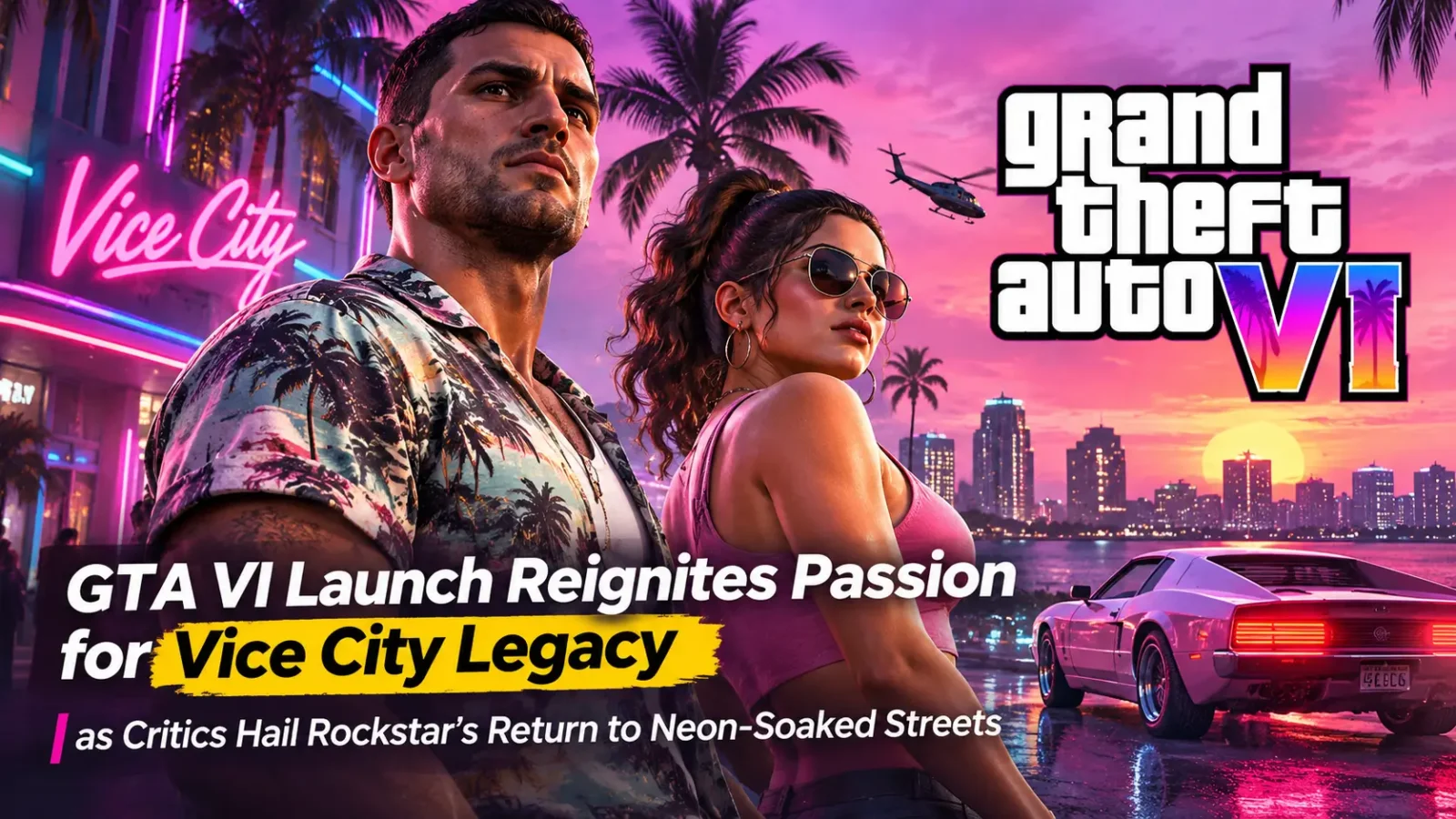
Vice City Returns to the Spotlight With GTA VI Release
The launch of Grand Theft Auto VI has triggered a wave of critical acclaim not seen since the original Vice City debuted over two decades ago. Reviewers across major outlets describe Rockstar’s latest as a technical and artistic milestone, with the reimagined Vice City serving as more than mere backdrop—it functions as a dynamic character in its own right.
Critics Unanimous in Praise for World Design
Publications including PCMag have labeled the new Vice City a “masterpiece I never want to leave,” citing the seamless blend of recognizable landmarks with fictionalized districts. The map reportedly spans multiple islands, swamplands, and urban corridors, each with distinct architectural identity, traffic patterns, and pedestrian routines that shift across day-night cycles and weather systems.
Unlike the 2002 original’s static environment, the new iteration features persistent world states: construction projects progress over in-game weeks, businesses open and close based on economic simulation, and gang territories fluctuate dynamically. This systemic depth extends to the Everglades-inspired wetlands, where wildlife behaves according to ecological logic rather than scripted spawns.
Dual Protagonists Anchor Narrative Innovation
Breaking from series tradition, GTA VI centers on a male-female duo whose intertwined arcs explore themes of loyalty, ambition, and survival in Vice City’s criminal underworld. Early coverage emphasizes how their contrasting perspectives—one a seasoned operator, the other a rising strategist—allow players to experience the city’s social strata from street-level hustles to high-rise boardrooms.
Mission design reportedly leverages this duality through asymmetric gameplay: one character excels at direct confrontation, the other at infiltration and social engineering. Players can switch perspectives mid-mission in certain scenarios, creating emergent tactical possibilities absent from previous entries.
Real-World Miami Reacts to Digital Doppelgänger
Not all attention has been celebratory. Bloomberg reports that some Miami residents and officials have expressed discomfort with the game’s satirical portrayal of their city’s cultural touchstones—from art deco preservation battles to climate gentrification debates. Local business owners near recreated landmarks describe mixed feelings about increased tourism driven by virtual recognition.
Rockstar has historically navigated such tensions through exaggerated parody that targets archetypes rather than specific entities. The studio’s legal team reportedly conducted extensive clearance reviews for branded elements, though the line between homage and appropriation remains contested in communities directly represented.
Legacy Content Bridges Generations of Players
Top Gear’s retrospective on the original Vice City notes how the 2002 title “truly hit its stride” for Rockstar, establishing the formula of licensed soundtracks, pop-culture pastiche, and character-driven crime drama that defines the series. The new release reportedly includes numerous easter eggs referencing Tommy Vercetti’s empire—from faded billboard advertisements to dialogue callbacks accessible only through specific exploration paths.
Data miners have already uncovered references to Ken Rosenberg, Lance Vance, and Ricardo Diaz embedded in environmental storytelling, suggesting Rockstar treats the franchise timeline as continuous canon rather than rebooted continuity. This approach rewards longtime fans while remaining accessible to newcomers drawn by the cultural moment.
Technical Achievement Sets New Industry Benchmark
Beyond narrative and design, reviewers highlight rendering innovations including real-time global illumination across the entire map, procedural interior generation for thousands of enterable buildings, and a physics-driven destruction system that calculates structural integrity per material type. The game reportedly maintains 60 frames per second on current-gen consoles during dense urban sequences—a feat attributed to Rockstar’s proprietary RAGE engine overhaul.
Audio engineering receives particular praise: the dynamic soundtrack system crossfades licensed tracks with an original score that adapts to player location, wanted level, and narrative tension. Radio stations feature hundreds of hours of original talk content, commercial parodies, and DJ commentary that references player actions in real time.
Post-Launch Roadmap Promises Evolving World
Rockstar has outlined a multi-year content plan including narrative expansions, seasonal events tied to real-world holidays, and a creator toolset allowing players to design custom missions within Vice City’s logic systems. The online component, launching separately, will reportedly support persistent player-owned enterprises that influence the shared economy—a significant evolution from GTA Online’s static property model.
With first-week sales projected to exceed $1 billion, the commercial stakes match the creative ambition. For a franchise that defined open-world gaming with Vice City’s neon glow in 2002, the 2026 return represents both a homecoming and a declaration that Rockstar still sets the pace others follow.
Frequently Asked Questions
Is GTA VI set in the same Vice City as the 2002 game?
Yes, Grand Theft Auto VI returns to a reimagined Vice City that expands significantly on the 2002 map. While iconic landmarks like Ocean Drive and the downtown skyline return, the new version adds multiple new islands, sprawling suburbs, wilderness areas, and a reworked street layout that reflects 20 years of fictional urban development.
Can you play as Tommy Vercetti in GTA VI?
No, Tommy Vercetti does not appear as a playable character. GTA VI introduces two new protagonists—a male and female lead—with original storylines. However, the game contains numerous environmental references to Vercetti’s legacy, including faded business signs, dialogue callbacks, and locations tied to his 1980s empire.
How does the new Vice City compare to real Miami?
Rockstar’s Vice City remains a satirical, fictionalized version of Miami—not a 1:1 recreation. While neighborhoods like South Beach, Little Havana, and Wynwood have clear analogues, the game compresses geography, exaggerates cultural stereotypes for parody, and invents entirely new districts to serve gameplay. Some Miami residents have criticized the portrayal as reductive, while others appreciate the cultural visibility.
Will GTA VI have a separate online mode like GTA Online?
Yes, Rockstar has confirmed a standalone online component launching after the single-player release. It will feature persistent player-owned businesses that affect a shared economy, seasonal narrative events, and a mission creator toolset. Unlike GTA Online’s static properties, enterprises in the new mode reportedly generate dynamic missions based on player decisions and market conditions.


Leave a comment